
AMPERE BRIEF
Redis on OCI Ampere® A4 Instances:
Redis on OCI Ampere® A4 Instances:
Price-Performance Leadership
Price-Performance Leadership
Executive Summary
In December 2025, Oracle announced the OCI Ampere® A4 Standard Instances as the latest Arm-based Cloud compute for performance and efficiency. The A4 product, based on the AmpereOne® M processor family, offers up to 96 cores and up to 700 GB of memory in Flex configurations as well as Bare Metal instances. The A4 instances were benchmarked and yielded up to 35% per-core performance improvements compared to the previous generation A2 instances.
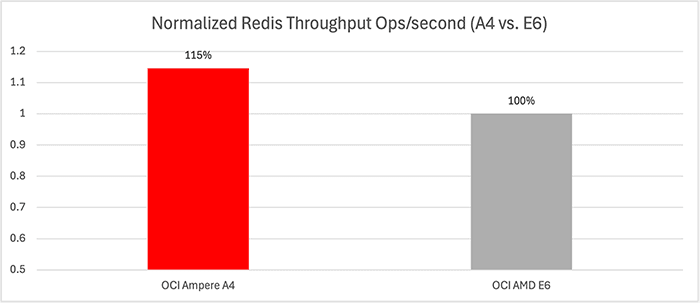
Redis has been the world’s most popular in-memory data store for over five years, consistently ranking as the #1 key-value database and maintained within the top 10 of all database systems globally, according to db-engines. Redis demonstrated 15% higher throughput compared to similarly equipped AMD ‘Turin’ based E6 instances. This led to 25% better price-performance on A4, which will result in lower Total Cost of Ownership (TCO) for cloud developers and infrastructure teams.
Overview
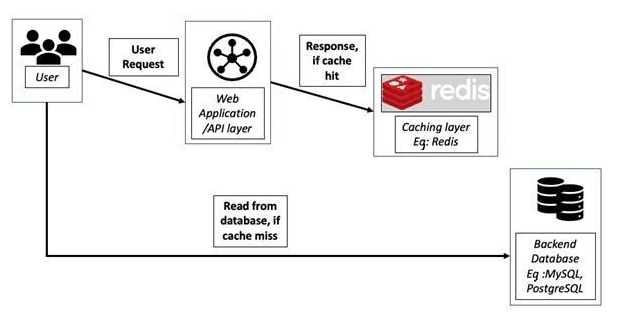
Redis, an open-source, in-memory key-value data store, is a cornerstone of modern cloud infrastructure, widely utilized as a high-performance database, cache, and message broker. Its inherent speed and ability to deliver high throughput at sub-millisecond latencies are critical for powering responsive applications and microservices at scale. As cloud environments continue to expand and workloads intensify, the demand for platforms that can not only handle increasing operational loads but also consistently meet stringent latency Service Level Agreements (SLAs) is paramount for ensuring optimal user experience and operational efficiency.
This workload brief benchmarks Redis on OCI A4 instances and compares them to similarly configured E6 instances, while imposing stringent latency SLAs on both solutions.
Test Methodology and Environment
Benchmarking for Redis performance was conducted under controlled and standardized conditions to ensure accurate, consistent, and reproducible results. The memtier benchmark (developed by Redis Labs) is used as a load generator to sufficiently saturate CPU. Additionally, recent compilers have made significant progress for code optimization on aarch64. For optimal results, the Redis server is compiled with gcc 15. Finally, network latency tests were performed across client to server to ensure viable test environments between platforms.
This rigorous approach minimizes external variables and provides a clear comparative analysis for cloud-native environments. The tests specifically focused on the key performance indicator of aggregate operations throughput while strictly adhering to a 1ms p99 SLA. Each test was subsequently run 5 times and the score represents GEOMEAN of those 5 runs under SLA of 1ms p99 latency.
This approach mirrors real-world operational requirements where responsiveness, reliability, and guaranteed performance are paramount for interactive and data-intensive applications. Our methodology therefore provides a comprehensive and practical view of processor capability under realistic and demanding Redis workload conditions.
OCI Ampere A4 instances have 1.15x higher throughput (measured as Redis operations/sec) compared to OCI AMD E6 instances.
This substantial gain in throughput translates directly to the ability to process a much higher volume of real-time transactions or data requests, making A4 instances ideal for high-volume caching, session management, and other latency-sensitive services.
End users will also see tremendous benefit in price performance compared with the E6 platform enabling more efficient cloud scaling on A4 in OCI.
| OCI Ampere A4 | OCI AMD E6 | |
|---|---|---|
| Cores/Threads | 16 | 16 |
| AOCPU | 8 | 8 |
| Memory | 128 | 128 |
| OS | Oracle9 | Oracle9 |
| Kernel | 6.12.0-106.55.4.2.el9uek.aarch64 | 6.12.0-106.55.4.2.el9uek.x86_64 |
| Pagesize | 4K | 4K |
| GCC Version | GCC15 | GCC15 |
| Topology | Client/Server | Client/Server |
Results and Key Findings
The following section details the compelling performance advantages observed when running Redis workloads on A4 processors. Its advanced capabilities to deliver better efficiency, scalability, and lower latencies for critical Redis cloud applications directly meet challenging infrastructure demands.
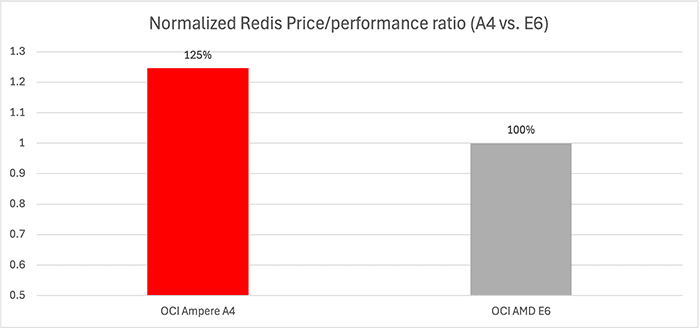
OCI Ampere A4 instances have 1.25x higher price-performance compared to OCI AMD E6 instances.
Conclusions
OCI Ampere A4 instances deliver superior performance for Redis workloads compared to E6, giving engineering teams confidence when evaluating future cloud infrastructure for high-performance data stores in OCI to meet performance expectations. That A4 platform’s ability to deliver significantly higher aggregate operations throughput, specifically under a stringent 1ms SLA, directly translates into more efficient resource utilization, enhanced scalability for growing Redis-dependent services, and a superior end-user experience for cloud-native applications.
Opting for A4 instances in OCI also provides a robust, cost-effective, and future-proof platform perfectly suited for the continually evolving demands of in-memory data management and high-performance caching in the cloud. This strategic adoption enables businesses to achieve faster data access, gain a competitive edge, and optimize their total cost of ownership (TCO) in the dynamic cloud landscape.
Footnotes
All data and information contained herein is for informational purposes only and Ampere reserves the right to change it without notice. This document may contain technical inaccuracies, omissions and typographical errors, and Ampere is under no obligation to update or correct this information. Ampere makes no representations or warranties of any kind, including but not limited to express or implied guarantees of noninfringement, merchantability, or fitness for a particular purpose, and assumes no liability of any kind. All information is provided “AS IS.” This document is not an offer or a binding commitment by Ampere. Use of the products contemplated herein requires the subsequent negotiation and execution of a definitive agreement or is subject to Ampere’s Terms and Conditions for the Sale of Goods.
System configurations, components, software versions, and testing environments that differ from those used in Ampere’s tests may result in different measurements than those obtained by Ampere.

Ampere Computing LLC
4655 Great America Parkway Suite 601
Santa Clara, CA 95054